The Personal Letter as a Practice of Attention
A personal letter gives a passing thought room to take shape. See how choosing details, drafting, and revising can make composition more deliberate.
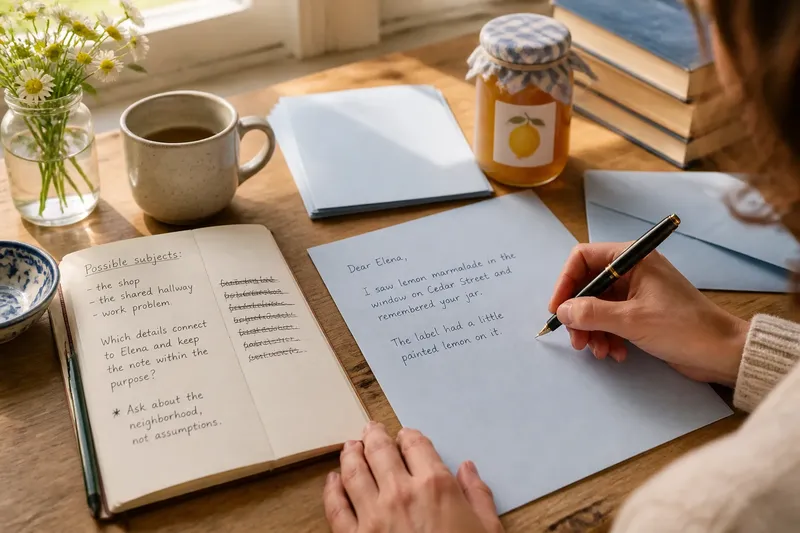
At the kitchen table, Mara turns a blank sheet of blue stationery sideways, then back again. She wants to write to her former neighbor, Elena, but the sentence in her head—“I’ve been thinking of you”—feels too broad to carry what she means. A personal letter can give that thought a slower, more deliberate shape, not by producing a particular feeling but by asking the writer to choose what to say next.
Imagine Mara’s situation as a fully invented one. She and Elena used to trade small notes across the hall; after Elena moved away, their messages became occasional and practical. Mara has just noticed a jar of lemon marmalade in a corner shop, the kind Elena once brought over, and decides to write rather than send a quick text. The point of the exercise is not a promised result. It is the work of composing: noticing, selecting, and shaping a thought for one particular reader.
A reader in mind
Mara starts by writing Elena’s name at the top of the page. That simple choice gives the letter an addressee. She is not trying to produce a polished account of her life or a general reflection on friendship; she is speaking to someone who remembers the hallway and the marmalade.
Before writing further, she considers what the note is for. She wants to share a small reminder and ask how Elena is settling in, without making the message sound like a request for reassurance or a demand for a long reply. That intention is modest enough to guide the writing without dictating every sentence.
A letter’s imagined reader can make vague thoughts more specific. “Things have been busy” might be true, but Mara can ask herself what she actually wants Elena to picture: the stack of library books by the sofa, the neighbor’s new blue door, or the jar in the shop window. Choosing one detail is part of paying attention, not a test of whether the detail is important enough.
Finding a first sentence
Mara first writes, “I hope you’re well.” It is courteous, but it does not lead toward the thought she wants to share. She leaves it on the page and tries another beginning: “I saw lemon marmalade in the window on Cedar Street and remembered your jar.” The second sentence gives the letter a place, an object, and a reason for writing.
There is no need to ban familiar openings. A greeting can be warm and ordinary; the useful question is whether it helps the writer move toward something they mean. Mara keeps “I hope you’re well” for a later line, where it fits naturally after the memory rather than carrying the whole message by itself.
She writes the next sentence without stopping to make it elegant: “The label had a little painted lemon on it.” The detail is visible and easy to follow. It also gives Elena something concrete to recognize, rather than asking her to respond to a broad statement about how much Mara misses their old conversations.
Choosing what belongs
As the draft grows, Mara lists three possible subjects in the margin: the shop, the shared hallway, and a work problem she has been worrying over. The letter does not have to contain everything on her mind. She chooses the shop and one brief hallway memory, because those details connect directly to Elena and keep the note within the purpose she set.
This is where composition can feel slower than texting. A writer has to decide whether a new thought belongs, how much context a reader needs, and whether a sentence changes the direction of the letter. Mara is not obliged to explain the whole history of the marmalade. She can give Elena just enough to recognize the memory, then move on.
She also notices a sentence that assumes Elena has been lonely in her new home. Mara cannot know that, and the guess would put a feeling into Elena’s mouth. She removes it. In its place, she asks a plain question about the neighborhood and leaves space for Elena to answer in her own way—or not to answer at once.
Revision without polishing away
When Mara rereads the draft, she is looking for sense, not literary brilliance. One sentence repeats the same memory twice; she crosses out the less clear version. Another sounds more formal than the way she speaks, so she changes “I was reminded of our previous exchanges” to “It made me think of our notes.” The revision makes the letter sound more like a message to Elena.
She checks the order as well. The marmalade comes first, then the hallway memory, then the question about Elena’s new neighborhood. That sequence gives each thought a place without forcing a grand ending. Mara closes with “Write when you feel like it,” a line that expresses welcome without setting a deadline.
Not every sentence needs to be kept just because it took effort to write. A draft is a workspace. Crossing something out does not erase the attention that went into deciding whether it belonged.
What readers often ask?
How long should a personal letter be?
Long enough to carry the thought you mean to share, and no longer simply to make the page look full. Mara’s note can remain brief because the memory and question are clear; another letter may need more room if the writer has more to explain.
Is handwriting necessary?
No. Mara chooses paper because she wants a page she can rearrange and mark, but a document or email can serve the same composing purpose. The useful distinction is not paper versus screen; it is whether the writer is making choices with the reader in mind.
What if the first sentence sounds awkward?
Write it anyway, then try another version beneath it. Seeing both sentences on the page gives the writer something specific to compare, rather than requiring a perfect opening to arrive before the letter can begin.
Should every letter be sent?
No. A writer can compose a letter without deciding to mail or send it, especially if the purpose is to clarify what they want to say. If Mara chooses to send hers, she can reread it once for names, tone, and whether the question leaves Elena room to respond freely.
From draft to result
Mara reads the finished note aloud at the kitchen table. She hears that the question about the neighborhood sounds curious rather than probing, and that the ending does not ask Elena to promise a reply. She copies the revised version onto the blue stationery, folds it into an envelope, and addresses it. The observable result is a letter ready to send, with a particular memory and a considerate question; it does not decide what Elena will feel or do.
The lesson in this invented situation is practical: a personal letter takes shape through small acts of attention. Name the reader, choose a concrete detail, leave out what does not serve the message, and revise for clarity and voice. Those decisions make the writing more deliberate while keeping its purpose grounded in the relationship between two people.
Before sealing an envelope—or clicking send—Mara can ask one last useful question: does this sound like something I would actually say to Elena? If the answer is no, a plain revision may do more than another decorative phrase. The letter is ready when its words belong to the writer and leave the reader room to be themselves.