Why a Habit Needs a Reliable Cue
A reliable cue helps a habit come to mind at the right moment, with practical ways to fix missed signals without expecting the action to become effortless.
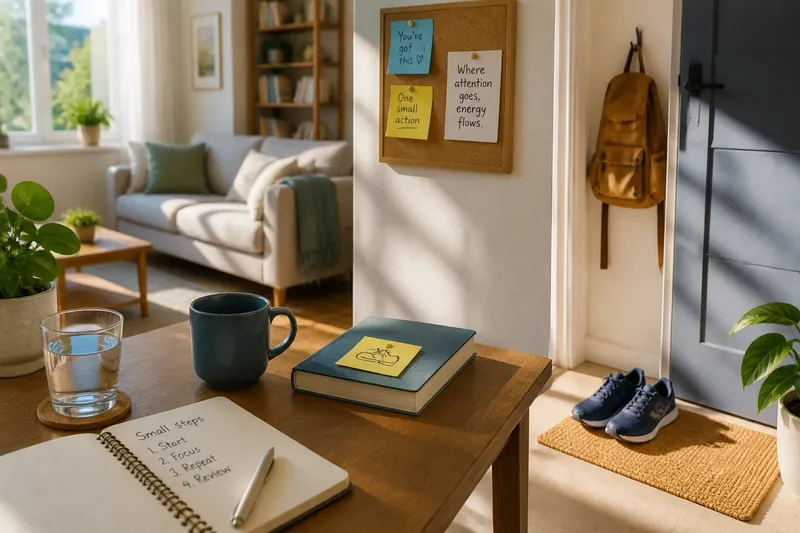
You set your mug beside the kettle, planning to stretch while the water heats. Then a message arrives, the kettle clicks off, and the stretch never happens. A reliable cue for a habit can help the action come to mind, but it cannot make every day predictable or turn repetition into effortless behavior.
The useful question is not simply, “How do I build a habit?” It is, “What will remind me to do this, and will that reminder still be there when the day gets messy?” Troubleshooting the cue first can spare you from blaming yourself for a plan that had no dependable signal.
When the cue disappears
A habit often stalls because its cue belongs to a routine that changes. “After breakfast” may sound clear, but breakfast can happen at home, at work, in a car, or not at all. If the action depends on a meal that does not reliably occur, the reminder disappears with it.
Choose an event you encounter more consistently, such as putting your phone on its charger or opening your laptop for the first time. The cue should be specific enough that you can recognize it without debating what counts. “After I sit down at my desk” is easier to spot than “sometime during work.”
Say you want to take a short walk. Imagine your starting point is a workday when lunch shifts around and you often forget the plan. If you attach the walk to putting on your shoes before leaving the office, the expected observable result is a clearer prompt on days you leave as usual; on days you work from home, you will still need another cue or a different plan.
When several cues compete
A cue can be present and still fail if the moment is crowded with other demands. A reminder on your phone may appear during a meeting, while a note on the refrigerator can blend into a surface covered with other notes. The problem may be competition, not a lack of motivation.
Make the signal visible at the point where the action can begin. Put the book on your pillow if you want to read before bed, or place a filled water glass near the spot where you start your morning. A cue works best when it is noticeable and the next action is easy to start from that location.
Try changing one feature at a time: the cue’s location, wording, or timing. A phone alert can say “open the sketchbook” rather than “be creative,” because the first phrase points to a visible action. If an alert interrupts an important task, move it to a transition you can notice without derailing what you are doing.
When the cue arrives too late
Sometimes the signal comes after the useful moment has passed. You remember to prepare lunch once you are already hungry, or recall a brief breathing pause only after opening a tense email. That usually means the cue is attached to the wrong point in the sequence.
Move it earlier, to the last dependable moment before the action is needed. If you want to bring a snack to work, a cue at the kitchen counter while packing your bag may be more useful than one at the office. The aim is not perfect timing; it is a signal that leaves enough room to act.
For actions tied to a transition, name both parts plainly: “After I close my laptop, I’ll put my walking shoes by the door.” This makes the cue observable and gives the action a natural place to begin. If the transition itself varies, choose a more stable one rather than adding a string of alarms.
When the action feels too large
A good cue cannot rescue an action that asks too much of the moment. “Exercise after work” can mean finding clothes, deciding what to do, and making time for a full session. Faced with all those decisions, you may see the cue and still put the plan off.
Define a small starting action that fits the situation: roll out the mat, put on walking shoes, or write one sentence in a journal. This is not a trick that makes the larger activity inevitable. It reduces the distance between noticing the cue and beginning; you can decide what comes next based on your time and energy.
Keep the intended action honest. If your aim is to practice guitar, opening the case is a start, not the whole practice. Naming that difference helps you use a small entry point without confusing it with completion or treating a short session as failure.
When interruptions break the chain
Some routines get interrupted for reasons you cannot control: a child needs help, a call runs long, or a bus arrives. A cue tied to one narrow window can fail even when you remember it. Repeating the plan at the same clock time may not solve a problem caused by an unpredictable schedule.
Decide in advance what counts as a reasonable alternate cue. If your usual prompt is arriving home, a second option might be putting your keys down after returning from an errand. Keep the alternative connected to the same action, but do not build so many backups that every moment becomes a reminder.
For a simple personal routine, you can also choose a low-pressure recovery rule: if the usual cue passes, try again at the next suitable transition rather than making up for the missed action. This prevents one disruption from turning into an all-or-nothing judgment. It does not mean every missed opportunity needs a replacement.
When repetition stays effortful
Reliable cues can support memory, but repetition does not promise that a habit will become automatic or enjoyable. A task may remain demanding because it is uncomfortable, complicated, or poorly suited to your circumstances. If you still have to think about it, that is not proof that you lack discipline.
Ask whether the action is still worth doing and whether its setup can be simplified. A nightly language lesson may be difficult because the materials are scattered across devices; keeping one workbook and a pencil in the usual spot could remove a decision. If the task itself no longer fits, changing the goal may be more sensible than strengthening the reminder.
Keep the cue steady while allowing the effort to vary. On a draining day, a short version may fit better than the full plan, provided it still serves your purpose. Some habits remain choices you make each time, even when the prompt is familiar.
How should you adjust the cue?
Should you use an alarm or a physical reminder?
Use an alarm when a particular time matters and your phone can alert you without creating another distraction. Choose a physical reminder, such as a notebook beside your chair, when the action belongs to a place or transition; it stays connected to the setting rather than demanding attention at a fixed hour.
What makes a cue specific?
A specific cue names an event you can notice, such as locking the front door or setting down your lunch container. Broad cues like “in the morning” leave you to decide when the prompt counts, which can create another small task.
What if you miss the cue?
First check whether the cue was visible and whether the action could begin at that moment. If not, adjust its placement or timing; if it was clear but the day changed, let the missed attempt be information rather than a verdict about you.
How long should you keep one cue?
Keep it while it remains noticeable, dependable, and connected to a useful action. Change it when your routine or surroundings change, rather than assuming the same signal must work in every season of life.
Keep the signal workable
When a habit slips, trace the moment backward: what was supposed to prompt it, was that cue present, and could you act when it appeared? That small check often points to a practical adjustment—move the reminder, choose a steadier event, or make the opening action clearer.
A reliable cue is a reminder, not a promise. For a habit to remain useful, it needs a signal that fits your real routine and an action you still choose to do. If either changes, revise the plan without expecting repetition to erase effort.